
Independent travel guide
Lama Temple
雍和宫Yōnghégōng
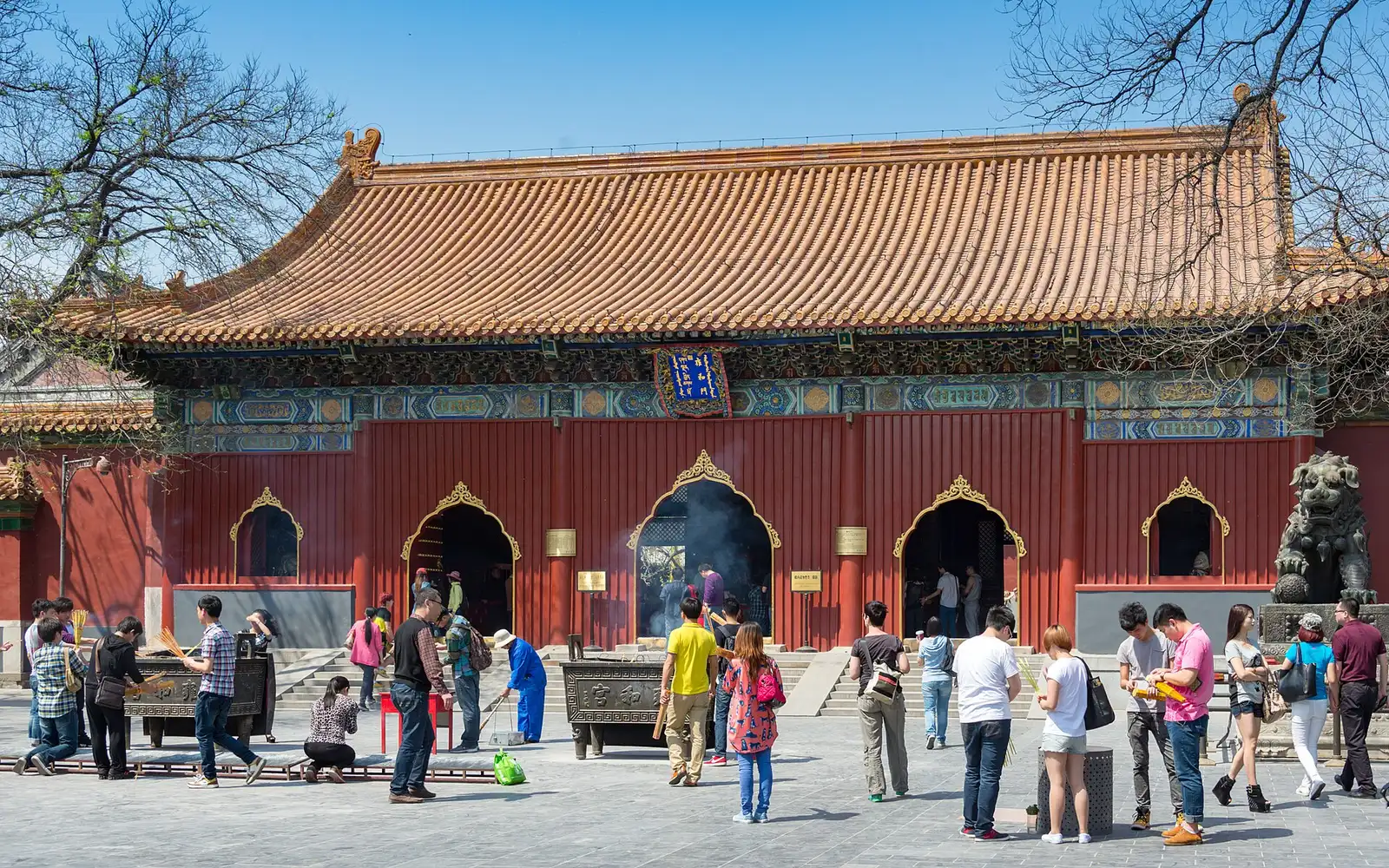
The Lama Temple remains an active Tibetan Buddhist monastery, so the route should be quiet and linear rather than treated as a photo checklist. Follow the central halls northward, let worshippers pass, and return along a side path.
Paid admission · Checked 2026-08-02
Verified ticket prices
Official pricesAdult admission ¥25
Adult admission
¥25- Use the official Yonghe Temple channel and bring the identity document used for booking.
- No qualifying admission-only or clearly admission-inclusive international-platform product was verified. Use the official channel.
Imported official ticket note
Adult ¥25, half ¥12 (minors 6–18, full-time undergraduates-and-below, seniors 60+); free for children under 6 or under 1.2 m, military personnel, veterans, fire-rescue staff and people with disabilities. The official explicitly authorizes no third-party ticket sales.
Research checked 2026-08-12Reservation required
How to book
The official “雍和宫游客信众服务” WeChat account is the primary real-name channel and its flow is China-local.
Book when the official window opens; high-demand dates can fill quickly.
Booking steps
- 1
Search WeChat for “雍和宫游客信众服务” and open ticket purchase.
- 2
Choose passport as the document type and enter the name and number exactly.
- 3
Pay in WeChat and save the order or QR code for the selected visit period.
Original passport and the official reservation record or QR code.
If the passport or payment flow fails, contact the temple or ask your hotel for current booking assistance before traveling there.
1.5–2 hours
How to visit
Main gate (Zhaotai Gate direction; No.28 Yonghegong Street, Dongcheng District, Beijing; about 250 m walk from Exit F southeast, Yonghegong Station, Metro Line 2/5). The east and west archways are street markers.
Return along the east side and continue to Wudaoying Hutong or the Confucian Temple.
- 1Stop 1The archways and Zhaotai Gate
Entrance with ticket sales/check; each person gets one free bundle of incense; a dharma-goods counter sits on the left of the entrance.
- 2Stop 2Hall of Heavenly Kings
Hall of Heavenly Kings: Maitreya and the Four Heavenly Kings; no incense or photography inside.
- 3Stop 3Yonghe Hall / Mahavira Hall
The main hall of the Buddhas of Three Ages.
- 4Stop 4Yongyou Hall
Amitayus Buddha hall; the west side of the hall points toward the Kalachakra Hall.
- 5Stop 5Falun Hall
Houses the bronze statue of Master Tsongkhapa—a core Tibetan-Buddhist hall; the Ordination Platform Building to the west was where the Sixth Panchen Lama lectured.
- 6Stop 6Wangu Pavilion (Ten Thousand Happinesses Pavilion)
The world's largest single-log-carved Maitreya Buddha, carved from a whole white sandalwood tree about 18 m tall—Yonghegong's iconic sight.
- 7Stop 7Suicheng Hall, the east/west side halls, and the Four Study Halls
Sutra-lecturing, Tantric, mathematics and medicine halls; you can also drop by the dharma-goods counter and consecration room on the way.
Best time
Arrive as early as possible after the weekday opening (09:00–10:00); avoid the 1st/15th, weekends and holidays. Ticket sales stop at 16:00 (winter)/16:30 (summer)—allow enough time.
Foreigner notes
Officially supported: passports and Hong Kong/Macau/Taiwan documents can buy full-price tickets; after successful online purchase you get an entry QR code to scan at the gate on visit day (no paper ticket needed). Half-price tickets require the original document at the 'Ticket Processing Centre' for paper tickets. The online flow can fully replace the ID card with the QR code.
Online purchase is done in the 'Yonghegong Visitors and Believers Service' WeChat account; WeChat registration and payment usually need a mainland China phone number and bound payment. If online fails, buy paper tickets at the on-site 'Ticket Processing Centre' window (the official confirms this on-site channel exists).
The official page doesn't publish payment methods; online is WeChat Pay inside the account, and on-site window payment is unverified.
No official English ticket page; photography is banned inside the halls—highlights are the architecture and Buddha statues. English audio guides are unverified.
Keep voices low, move around rather than through prayer lines, and obey hall-specific photography notices.
Avoid these mistakes
On the 1st/15th of the lunar month, Buddhist festivals and Spring Festival, crowds are huge and queueing to buy tickets/enter can exceed an hour. Avoid these dates; arrive at opening on ordinary days, and check the official 'reception guarantee notice' for same-day arrangements.
Burning incense, photography and video are banned inside the halls; not knowing the etiquette can get you corrected. Burn incense at the outdoor urns (three sticks is appropriate; each person gets one free bundle), and put away phones/cameras inside. In windy weather the temple stops incense burning.
Third-party platforms and scalpers resell tickets; the temple has never authorized any third-party sales. Buy only via the 'Yonghegong Visitors and Believers Service' WeChat account or the on-site 'Ticket Processing Centre' window.
Online tickets limit each valid document to 1/day and each WeChat account to 5, so buying for many people often fails. Each companion should buy with their own document/WeChat; foreign visitors buying full-price tickets can enter with the QR code even without entering an ID number.
Ticket sales/entry stop earlier than closing time (16:30 summer, 16:00 winter), leaving afternoon visits short. Plan around the 'ticket-stop time' and allow at least 1.5 hours.
The Wangu Pavilion's Buddha is a wooden relic; the hall is crowded and viewing/photos are restricted. Follow staff's one-way flow, don't linger and don't use flash.
Continue nearby
Confucian Temple and Imperial College Museum1.5–2 hoursForbidden CityAbout 3.5–5 hours (half a day).Temple of Heaven Park2-3 hours (Beijing Tourism Network suggests 2 hours; existing project leads say 2-3 hours; allow 3 hours with the combined core-site ticket)Beijing seasonal itinerary guideBeijing itinerary and seasonal travel guide for a 4–5 days first visit.Beijing food guideIncludes spice, ingredient, allergen and ordering notes for independent travelers.Beijing Travel Guide & MapBeijing travel guide and interactive map for independent travelers.
Sources and evidence
Published by China Trip Primer · Read the editorial and verification methodology
Items to reconfirm
- Payment details aren't officially published; whether online payment in the 'Yonghegong Visitors and Believers Service' account (WeChat Pay) supports international cards is unverified. — Call 010-84191906/84191907 to confirm, or buy directly at the on-site window.
- WeChat registration and payment usually need a mainland China phone number; the official site doesn't state online-booking feasibility for foreign visitors without one. — Buying paper tickets at the on-site 'Ticket Processing Centre' window is the officially recognized backup channel.
- Route stops are compiled from the official 'temple layout/halls and Buddhas' section and public sources; no fixed visiting route is officially published. — Follow the on-site guide map, or check the official 'Yonghe Overview — Temple Layout' section.
- The opening-hours page was published in 2017, but ticket pages still cite the same hours; holidays and Buddhist events have separate reception notices. — Check the official 'Yonghe News' latest notice before travelling.
Official
OfficialLama Temple visitor noticePublisher · Lama Temple
Used forEntry rules, worship etiquette and visitor flow
Published 2021-03-13 · Verified 2026-07-29OfficialBeijing Yonghegong visit ticket prices (incl. purchase notes, ticket-check/refund rules)Publisher · Yonghe Temple official site (www.yonghegong.cn)Used forUsed to verify the imported ticketing, booking, opening-hours or visitor-guidance fields.
Verified 2026-08-12OfficialBeijing Yonghe Temple opening hoursPublisher · Yonghe Temple official site (www.yonghegong.cn)Used forUsed to verify the imported ticketing, booking, opening-hours or visitor-guidance fields.
Verified 2026-08-12OfficialYonghegong official homepage — opening-services section guidePublisher · Yonghe Temple official site (www.yonghegong.cn)Used forUsed to verify the imported ticketing, booking, opening-hours or visitor-guidance fields.
Verified 2026-08-12Community experience
Venue-specific official pages are used where available. City-level official references provide context and are not booking confirmation; editorial and community sources are used only for route choices, pacing and first-hand experience.
雍和宫雍和宫大街28号(雍和宫地铁站F东南口步行250米)